
Capabilities · Gebrema
DFM · Manufacturability Review.
We review your drawing before we quote, a manufacturability review (also called design for manufacturability, DFM). If we can make it run better, with faster cycles, fewer rejects and lower cost per piece, we will tell you. Your functional requirements stay the constraint, your part stays yours. The process becomes the advantage.
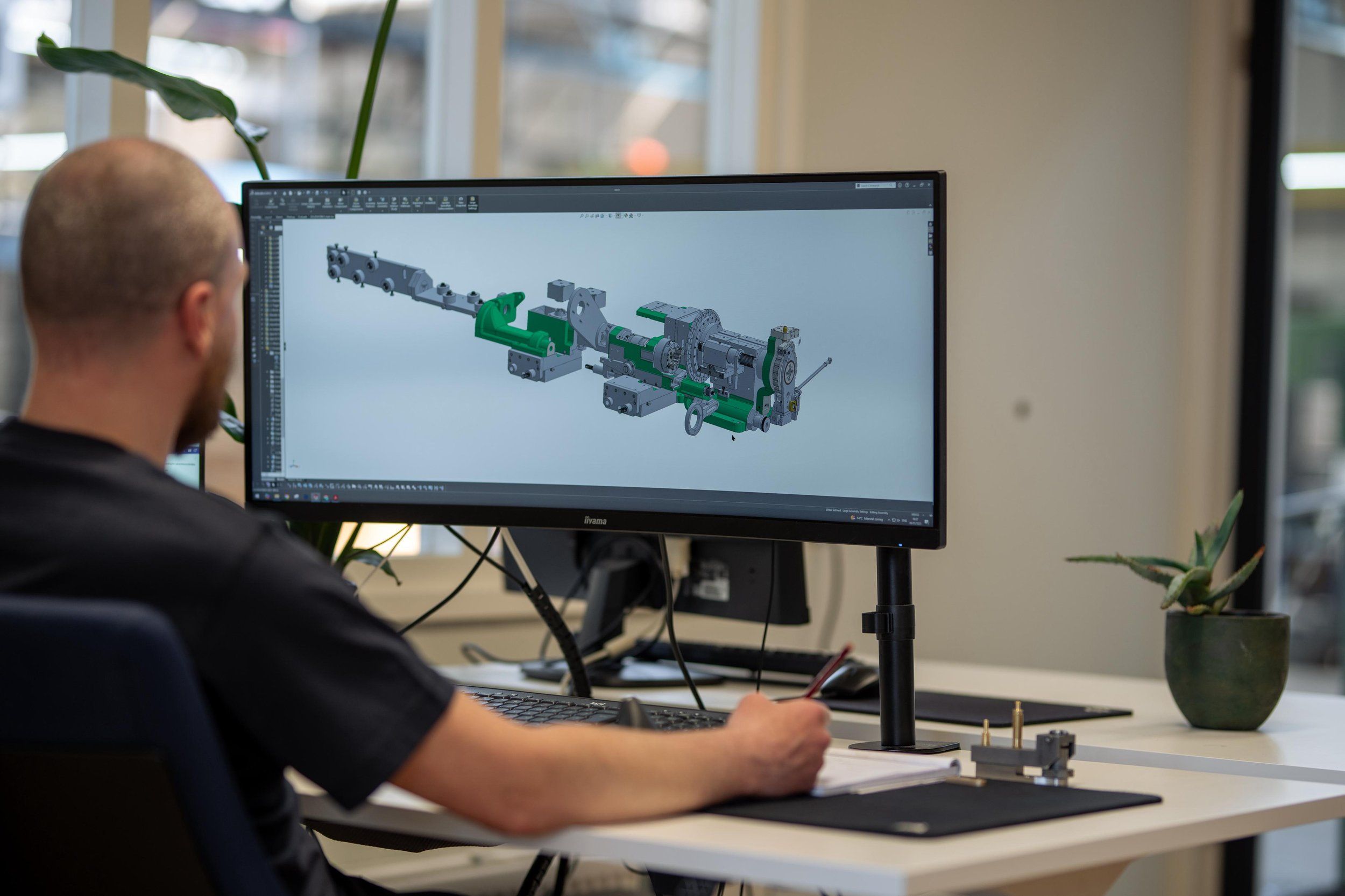
Before production starts, our engineers review every drawing for machinability. This is not a formality. It is where the cost of the part at volume is decided. A small change to a radius, a thread relief or a tolerance band can mean the difference between a part that runs at full machine speed and one that needs constant intervention. We review the drawing and propose refinements; your functional requirements stay the constraint and the decision stays yours. If you are bringing a new part to volume, this review at the start of the relationship is one of the most valuable things we offer.
On a new part, the choices made before the drawing is frozen decide what it costs at volume. Bring us in early and we will look at what is possible.
It matters because our rotary transfer machines turn a finished part in a single pass, with no secondary machining. Getting the drawing right up front is what lets the part run that way, at full speed and at volume, and from there we manage every step through to delivery.
From drawing review to first article.
- Drawing review: every new part is assessed for technical viability, tolerances, material suitability and machinability before tooling is ordered, not after first production.
- Design optimisation: where the drawing can be adjusted to improve machinability without compromising function, we propose the change. You decide.
- Tooling engineering: all tooling is designed, ordered and maintained in-house, a significant investment that locks in production quality for the life of the relationship.
- First article approval: samples with dimensional reports (and material certificates, if requested before the order) are submitted for customer sign-off. Volume production starts only once approved.
Surface treatment, coordinated and inspected.
Where a specification requires plating, nickel, zinc, silver, copper-nickel or copper-nickel-silver, we coordinate the entire process through a network of qualified, pre-audited finishing partners. We manage the logistics, track the batch, conduct final inspection on return, and release only treated parts that meet specification. You do not need to manage the plating relationship or inspect incoming treated parts. The part that arrives is complete, inspected and certified, with full material and treatment traceability on request.
The production flow
Engineering and tooling.
Engineers assess the drawing for technical and commercial viability. Tooling is designed and ordered in-house. The machine is set and validated before production starts, not after.
Raw material.
Material is contracted and approved to specification. Coils are assigned to the production machine and inspected on arrival. Traceability is maintained throughout.
Production and inspection.
The machine runs, unmanned for up to 16 hours a day where the programme allows. Quality control inspects parts in-process and at final stage. Parts that do not meet specification do not leave the factory.
Finishing and delivery.
Degreasing is done in-house and, where required, surface treatment is coordinated through pre-audited partners. Final inspection precedes packing to your specification and dispatch, with kanban and call-off supported.
Manufacturability review questions
What buyers ask about DFM.
What is a manufacturability review (DFM)?
Before production, Gebrema's engineers review your drawing for manufacturability and tell you whether and how the part runs better, faster or cheaper in high-volume turning. The product and its intellectual property stay entirely with you.
Does Gebrema redesign or take ownership of my part?
No. A manufacturability review assesses your existing design and suggests production-oriented improvements; it does not take ownership of the design. Product and IP remain the customer's.
How fast is a manufacturability review?
Gebrema confirms your request within one business day. The manufacturability review itself takes longer: assessing whether and how the part can be produced, with any engineering notes that affect cost or lead time, follows once the drawing and annual volume are in.