
Capabilities · Gebrema
Rotary Transfer Machining.
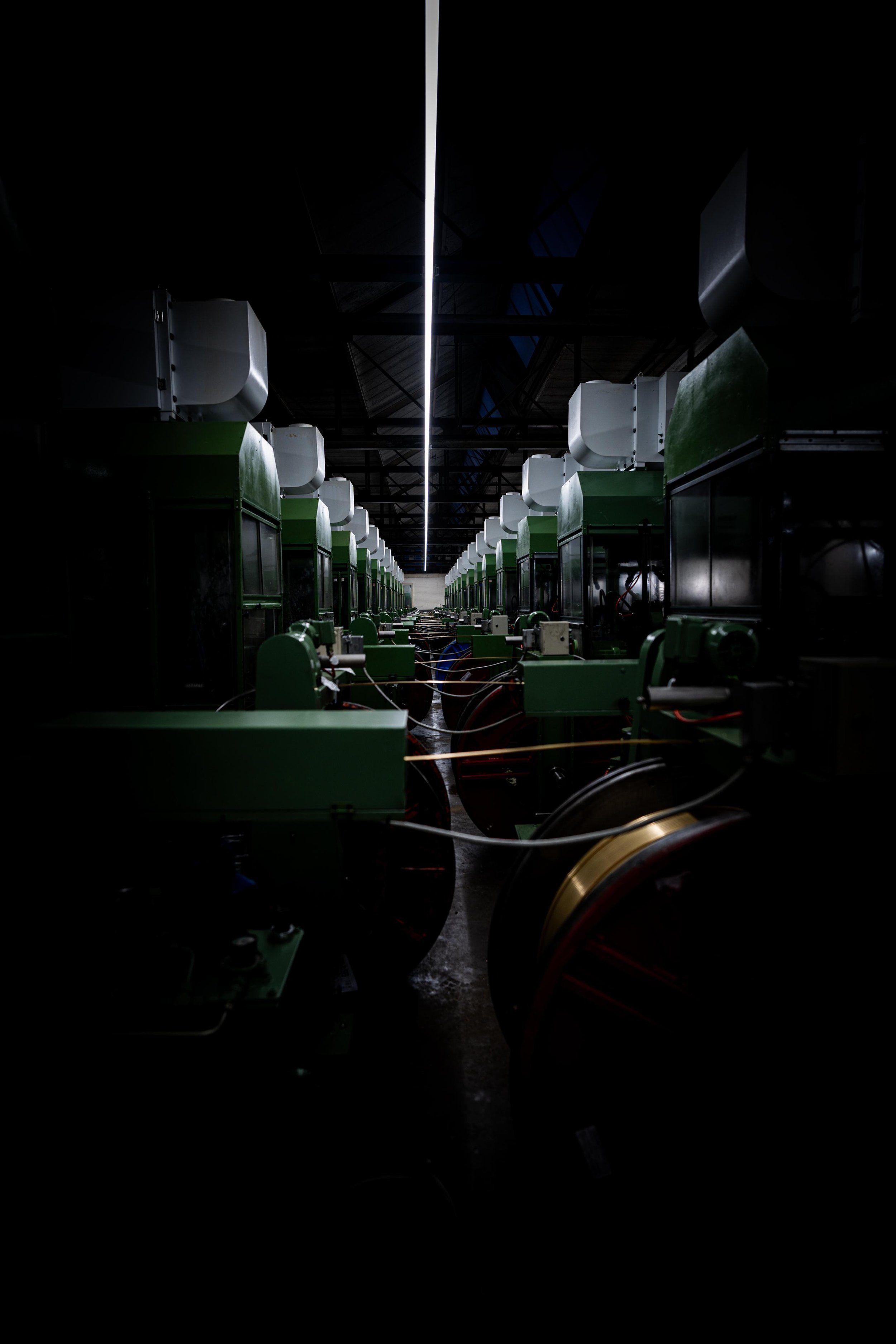
Eighty machines, running around the clock. This is the model that keeps us supplying Europe's OEMs at high volume, and it is why our customer relationships average more than twenty years.
This process is not for sale off a shelf. We built it in-house.
We operate 80 MAG-EUBAMA S8 rotary transfer machines, all continuously refined in-house over 50 years. These are not standard machines running standard processes. Every machine in the fleet has been modified, recalibrated and optimised by our own engineers to maximise uptime, reduce cycle time and hold tolerances without constant operator intervention. That process mastery took decades to build.
The machine runs. Your line does not stop.
Most precision turned parts manufacturers need continuous operator attention to hold quality at volume. When the operator goes home, the machine either stops or output quality degrades. Our in-house process refinement eliminates that dependency. Tolerances hold, shift after shift. With maintenance and quality checks by day, the process stays stable enough to run unmanned for up to 16 hours. This is the technical foundation of our supply reliability. It is not a claim, it is an engineering outcome, and it is why our customer relationships average more than 20 years.
What rotary transfer delivers.
- Volume from 500,000 to 250,000,000+ parts per year, per customer.
- Rotary transfer runs ⌀3 to 11 mm, the envelope for connectors, spacers, contact pins and fastener-type parts. Above that, to ⌀26 mm, parts run on CNC turning.
- Nights run with no operator on the floor: Monday's parts identical to Friday's.
- Dedicated machine allocation for long-term volume: as your annual demand grows, so does the capacity reserved for you, from one machine to several. Never shared, never queued.
How rotary transfer works
The wire holds still. The tools turn around it.
This is ring turning, the inverse of a lathe: in this example, the wire is clamped and the tooling orbits it to cut the profile. A saw releases each piece, and the clamping ring then drills, cross-drills, taps and indexes it out. One mechanical cam shaft drives every motion in step, with no CNC and no code, so every turn of that shaft sends out one finished part, generally faster than any CNC lathe. Cycle time is the slowest single cut, not the sum of them all.
Rotary transfer at Gebrema
The production facts, in plain numbers.
Gebrema runs 80 dedicated rotary transfer machines (83 machines in total) in Weesp (Amsterdam), producing 400+ million precision turned parts per year. 94% is exported across Europe and beyond. Materials: brass, lead-free brass, steel, lead-free steel and stainless steel, machined from coil. Commercially attractive from 500,000 pieces per part number per year.
| Rotary transfer machines | 80 dedicated, out of 83 machines in total |
|---|---|
| Annual output | 400+ million precision turned parts per year |
| Diameter range | ⌀3–11 mm on rotary transfer; to ⌀26 mm on CNC turning |
| Materials | Brass, lead-free brass, steel, lead-free steel and stainless steel, machined from coil |
| Commercial volume | From 500,000 pieces per part number per year |
| Running time | 24/7, up to 16 hours of it unmanned |
| Quality system | ISO 9001:2015 certified |
The model in numbers
Rotary transfer vs CNC turning
Which process fits your part.
Gebrema runs both. Rotary transfer wins on unit cost at high, repeat volume; CNC turning covers launch, lower volume, ramp-up and larger dimensions. Parts can start on CNC turning and move to rotary transfer as annual demand grows.
| Comparison | Rotary transfer | CNC turning |
|---|---|---|
| Best for | Long-term, repeat high volume | Launch, lower volume, ramp-up, larger dimensions |
| Minimum volume | 500,000 pieces per year | 10,000 pieces per part number, within an annual programme of at least 50,000 pieces |
| Diameter range | ⌀3–11 mm | up to ⌀26 mm |
| Machines | 80 MAG-EUBAMA S8 | Traub and Tornos multi-axis |
| Running | 24/7, 16 hours of it unmanned | Attended |
| Unit cost at volume | Lowest | Higher |
Rotary transfer questions
What buyers ask about rotary transfer.
What is rotary transfer machining?
Rotary transfer machining holds many parts at once and brings the tools to them, so a part is turned, drilled, cross-drilled and tapped in one continuous cycle. Gebrema runs 80 MAG-EUBAMA S8 machines this way, finishing a complete part every cycle, generally faster than CNC and at a unit cost CNC turning cannot match.
What production volumes does rotary transfer suit?
From 500,000 to 250,000,000+ pieces per year, per customer. Rotary transfer is built for long-term, repeat production past the prototype phase, not one-offs. For lower volumes and new product introductions, Gebrema uses CNC turning from 10,000 pieces per part number, within an annual programme of at least 50,000 pieces.
What diameter range can Gebrema turn on rotary transfer?
Rotary transfer runs ⌀3 to 11 mm, the envelope for connectors, spacers, contact pins and fastener-type parts. Above that, to ⌀26 mm and up to 200 mm in length, parts run on CNC turning.
What is the minimum annual volume?
Rotary transfer starts at 500,000 pieces per part number per year. CNC turning runs from 10,000 pieces per part number, within an annual programme of at least 50,000 pieces. Below 50,000 pieces a year Gebrema does not quote.
Rotary transfer or CNC turning: which is cheaper for my volume?
Above 500,000 pieces per part number per year, rotary transfer gives the lower unit cost: one cam-driven cycle produces a finished part, generally faster than CNC turning. Below that, the tooling and set-up of a dedicated rotary transfer station are not earned back and CNC turning is cheaper, from 10,000 pieces per part number within an annual programme of at least 50,000 pieces. The comparison table on this page sets the two processes side by side.
What tolerances can Gebrema hold?
Critical dimensions are held to a few hundredths of a millimetre; 0.01 mm is the tightest the process holds. An example from production: 3.48 ±0.03 mm. There is no surcharge model. Gebrema either meets the drawing tolerance or declines the part, and the manufacturability review confirms before quoting what is achievable for your geometry, material and volume.
Which materials run on rotary transfer at Gebrema?
Brass, lead-free brass, free-cutting steel, lead-free steel and stainless steel. Gebrema is at the forefront of lead-free brass production.
How does Gebrema hold quality overnight, with nobody on the floor?
Decades of in-house process refinement let the machines hold tolerances for up to sixteen unmanned hours, so Monday's parts are identical to Friday's, to within your specification. It is why Gebrema has never caused a stoppage at a customer's line and why customer relationships average more than 20 years.